
Here at Motovated, a lot of our work ultimately results in some form of certification being issued to the client – especially for our Safety & Compliance and Non-Structural Seismic Restraint business units. We are often asked by our clients to provide “certificates” or “certification” but because these generic terms, confusion can arise about exactly what the client requires.
To help with this confusion, we have put together a summary of the different deliverables we can issue that come under the general heading of “certification” so that the differences between these are clear. There are other types of certificate that other provide, and some of these interact with some of the work we do, but only the certificates Motovated can offer are covered here.
Engineer’s Certificate:
There are many items in common use across industry that must or should be certified by an engineer. These certification requirements are typically based on the Health and Safety at Work Act, and may be imposed via regulations, approved codes of practice, best practice guides or other guidance from Worksafe. For these items, we would issue an Engineer’s Certificate signed by a Chartered Professional Engineer (CPEng).
Items that typically require CPEng certification include lifting beams, crane lifted work platforms, forklift mancages and lifting jibs, etc.
An engineer’s certificate is only issued for a specific item of equipment, usually uniquely identified by a serial number. An engineer’s certificate does not apply to a design (see “Design Statement” below). Since the certificate is for a particular item of equipment, it will be based on QA functions like weld inspections and proof loads, in a way that does not apply to a design statement.
An engineer’s certificate is a document that states the opinion of the CPEng, held on reasonable grounds, that a particular condition is true. For example, for a lifting beam, the CPEng certificate would state the Working Load Limit of the beam.
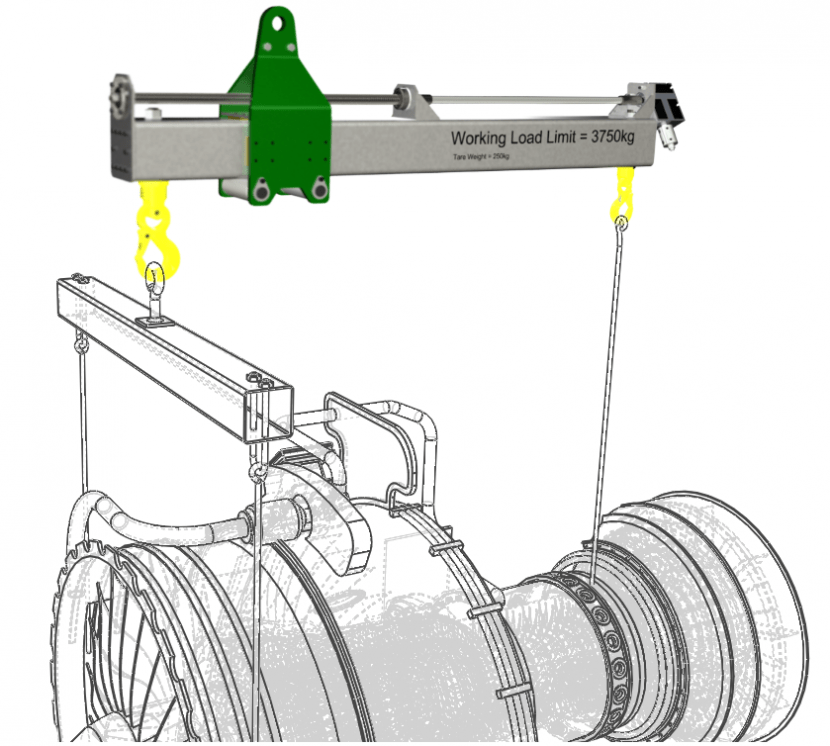
Dynamic Lifting Beam – Courtesy of Christchurch Engine Centre
An engineer’s certificate is usually a paper or electronic document, and is typically accompanied by a certification plate to be attached to the equipment. This states critical information from the certificate in a durable form on the equipment where the information is easily accessible.
Design Statement
A design statement is similar to an engineer’s certificate, except that it relates to a design rather than to a specific item equipment. A design statement will not be accompanied by a certification plate, but will instead reference a set of drawings that document the design.
A design statement typically follows a format quite similar to an engineer’s certificate, and like a certificate is a statement of opinion held on reasonable grounds.
Since a design statement applies only to the design, it cannot be taken as certification of a specific item, since the performance of one item made to the design will also depend on manufacturing quality, weld quality, etc.

Hot Water Cylinder Seismic Analysis – Courtesy of David Brown Contractors
Design statements should not be thought of as a cheaper alternative to a engineer’s certificate, because the balance of risk is different. If being asked to issue a design statement for a design that will be reused, the issuing engineer is likely to charge significantly more for the statement than for an engineer’s certificate, because more risk is being taken on by the engineer. Even then, the manufacturer of the items may find that they have not sufficiently managed risk, since the design statement provides no assurance about manufacturing quality or the performance of any one item, so a significant amount of risk remains with the manufacturer.
Producer Statement (PS1 – Design):
Producer Statements are a type of certification that is typically used for work covered by the NZ building code. Colloquially these are referred to simply as PS1s, PS2s, PS3s and PS4s.
A PS1 is similar in function to a design statement – it is a statement of opinion, held on reasonable grounds, that a particular design will satisfy the requirements of a particular clause of the building code. A PS1 will reference drawings that document what the design is, and will be issued by a competent person – in Motovated’s case, a Chartered Professional Engineer.
For example, Motovated routinely issue PS1s from our non-structural seismic restraint unit, stating that a particular bracing design will satisfy clause B1: Structure of the building code.
When a PS1 is issued, it will generally be accompanied by supporting calculations, drawings, statements of assumptions and recommended construction monitoring.
At Motovated we use the standard Engineering NZ template for PS1s.
Producer Statement (PS2- Design Review):
A PS2 is similar to a PS1, in that it is a statement about a particular design. The difference is that, where a PS1 will be issued by a designer about their design, a PS2 would be issued by a peer reviewer.
Essentially, a PS2 is a statement from a design reviewer that they believe, on reasonable grounds, that a design issued by another party will satisfy the requirements of a particular clause of the NZ building code.
At Motovated we use the standard Engineering NZ template for PS2s.
Producer Statement (PS4 – Construction Review):
A PS4 is a construction review certificate. It states that a particular competent person has carried out construction monitoring inspections to check the installation of some element covered by a building consent.
A PS4 will specify the level of construction monitoring that has been carried out (CM1 – CM5) and end with a statement from the construction reviewer that they believe, on reasonable grounds, that the installed works match the design documented in the building consent.
Construction monitoring needs to be carried out by persons familiar with the design, so generally PS4s are issued by the same people and/or firm that carried out the original design and issued the PS1.
At Motovated we use the standard Engineering NZ template for PS4s.
The hazardous substances regulations require all stationary tanks and process containers over 250 litres capacity (which contain hazardous substances) to comply with those Regulations. Above specified threshold volumes a Stationary Container Design Compliance Certificate is required to verify compliance with the relevant Regulations. There are no prescribed validity periods for Design Certificates, since these apply to the design rather than to any specific container – these are analagous to a design statement, rather than an engineer’s certificate.
The HASWA Regulations require installed stationary tanks and process containers (over specified volumes) to be issued with a Stationary Container Compliance Certificate. The Certificate verifies compliance with Regulations in relation to:
- Tank design
- Tank construction
- Tank installation
- Pressure management
- Emergency pressure management
- Level indicators
- Lightning and stray current protection
- Separation
- Fire fighting
- Marking
- Plans
- Secondary containment
- Specific requirements in relation to vapourisers, burners and engines
- Pipework
- Valves
- Records
- Repairs or alterations
- Dispensers
The validity periods for various installed systems are prescribed by the Regulations / Safe Work Instruments (SWI)
All road tank wagons greater than 450 litres capacity are required to be issued with a Tank Wagon Design Certificate to verify compliance with the design requirements of the Regulations. Client must provice technical drawings, calculations and specifications for each design component when applying for a design compliance certificate. Once the regulations are met, the certifier will issue a TAN number. There are no prescribed validity periods for Tank Wagon Design Certificates.
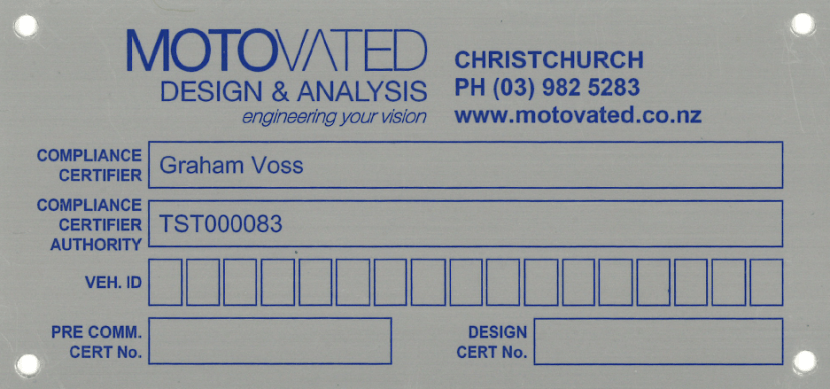
Sample template of Tank Wagon Design Compliance Certificate
Before a tank wagon can be used it must undergo a Pre-Commissioning Inspection and be issued with a Pre-Commissioning Compliance Certificate to verify construction and marking in accordance with the approved design and the relevant regulations. Marking includes the allocation by WorkSafe of a unique TAN or approval number. There is no prescribed expiry date for a Pre-Commissioning Certificate.
Tank wagons are due an In-Service Inspection and Certificate two years after the issue of the Pre-Commissioning Certificate and at recurring 2 yearly intervals.
The In-Service inspection and Certificate is required to verify maintained compliance with Regulations and original design much the same as for a vehicle Warrant of Fitness
Approved Fabricator Certificate:
A tank manufacturer can apply to become an approved fabricator and be allocated an FAB number. Once approved the FAB number is entered on the WorkSafe Public “Stationary container system design and fabricator record”. The process involves conducting a physical audit of the fabrication premises and review of processes, procedures, qualifications, equipment, testing and record keeping.
The process allows a manufacturer to mass produce a specific tank design (TNK) without individual tank design certification and fabrication verification. The maximum validity period for an Approved Fabricator Certificate is 3 years.
About the Author

Senior Safety & Compliance Engineer
Joe has spent most of his career as a consulting engineer, working across a range of industries. The current focus of his work is health & safety and compliance engineering. This covers a wide range of areas, including machinery safety, hazardous substance storage design, seismic assessment of plant and equipment, equipment design & certification, and any other area of engineering work driven by safety or standards compliance.
Joe is a regular provider of Continuing Professional Development (CPD) courses to engineers via Engineering New Zealand, especially in the area of Health & Safety Engineering. He also provides expert witness and investigation support services to regulators and other clients.